Abstract
Medically supervised low-energy total diet replacement before staged arthroplasty in severe obesity and type 2 diabetes
Yazmine P. Huizar PhD, DBSM, Shannon Galyean PhD, RDN, Antonio F. Pagan PhD
Corresponding author: Yazmine P. Huizar
Contact Information: Yazmine@dreamwellpsychology.com
DOI: 10.12746/swjm.v14i61.1675
ABSTRACT
Low-energy total diet replacement (TDR), when combined with medical monitoring, may support preoperative metabolic optimization in selected patients with severe obesity and type 2 diabetes (T2D). We report the case of a 57-year-old woman with severe obesity, type 2 diabetes, chronic prednisone exposure, obstructive sleep apnea, hypertension, and limited mobility who enrolled in a medically supervised total diet replacement (TDR) program to improve her candidacy for staged arthroplasty. At baseline, her weight was 312 lb (141.5 kg), her body mass index was 57.1 kg/m2, and her hemoglobin A1c was 7.6%. The intensive phase provided approximately 960 kcal/day through formula-based meal replacement products and included weekly clinical visits, medication reconciliation, laboratory surveillance, electrocardiographic monitoring per clinic protocol, behavioral support, and perioperative dietary planning coordinated with the orthopedic team. Her weight decreased to 222 lb (100.7 kg), representing a 28.8% total body weight loss. Hemoglobin A1c decreased to 5.0%; lisinopril and potassium chloride were discontinued at week 5, and metformin was discontinued at 11 months. Hemoglobin A1c remained below 6.5% for at least 3 months after cessation of glucose-lowering therapy, meeting consensus criteria for T2D remission. The patient subsequently underwent staged left hip and right knee arthroplasty, with uncomplicated wound healing and no documented postoperative infection. This case illustrates a medically supervised, interdisciplinary pathway for high-risk arthroplasty candidates while emphasizing that findings from a single patient cannot establish causality or determine whether the intervention reduced perioperative risk.
Keywords: Preoperative Care; Diet, Reducing; Arthroplasty, Replacement; Diabetes Mellitus, Type 2; Weight Loss; Obesity, Morbid
INTRODUCTION
Severe obesity is associated with an increased risk of complications and greater resource utilization after hip and knee arthroplasty, particularly among patients with very high body mass index.1 Type 2 diabetes (T2D) and perioperative hyperglycemia further increase the risk of adverse arthroplasty outcomes, including periprosthetic joint infection.2 Preoperative optimization therefore increasingly emphasizes modifiable metabolic risk factors rather than surgical “clearance” alone.3
Formula-based total diet replacement (TDR) programs can produce substantial weight loss and glycemic improvement when delivered with structured follow-up and medication adjustment.4,5 In patients with T2D, negative energy balance can improve hepatic insulin sensitivity and reduce glycemic burden, providing a biologic rationale for medication de-escalation following marked weight loss.6 Consensus criteria define T2D remission as a hemoglobin A1c (HbA1c) level below 6.5% measured at least 3 months after discontinuation of glucose-lowering therapy.7 This case describes a medically supervised, low-energy TDR pathway used before staged arthroplasty in a high-risk patient with severe obesity and T2D. The case was prepared in accordance with the CARE guidelines.8
CASE REPORT
A 57-year-old woman presented to a university-affiliated metabolic health clinic seeking medically supervised weight loss to improve her candidacy for staged arthroplasty. She reported obesity since childhood and multiple prior unsuccessful weight loss attempts. Severe pain and limited mobility necessitated wheelchair use. Because she was unable to stand for height measurement, her height was obtained from primary care records. At presentation, her weight was 312 lb (141.5 kg), height was 5 ft 2 in (157.5 cm), and body mass index was 57.1 kg/m2. Initial vital signs included a blood pressure of 103/84 mmHg, heart rate of 88 beats/min, and oxygen saturation of 96%.
Medical history included T2D, hypertension, systemic lupus erythematosus treated with prednisone 5 mg daily, obstructive sleep apnea treated with continuous positive airway pressure, seizure disorder, chronic pain, bilateral 3+ pitting lower-extremity edema, depression, and anxiety. Baseline medications included metformin, lisinopril, potassium chloride, prednisone, metoprolol, duloxetine, gabapentin, hydroxychloroquine, cyclobenzaprine, clonazepam, montelukast, estradiol, albuterol, and analgesics. A baseline echocardiogram demonstrated mild concentric left ventricular hypertrophy, diastolic dysfunction, mild tricuspid regurgitation, mild pulmonary hypertension with an estimated pulmonary artery systolic pressure of 34 mmHg, and a left ventricular ejection fraction of 55%–60%.
Baseline HbA1c was 7.6%, with a serum glucose level of 85 mg/dL. This apparent discordance was interpreted in the context of established T2D and metformin use, while acknowledging that HbA1c may be misleading in conditions that affect red blood cell turnover.9 Chronic prednisone exposure was considered an additional interpretive factor, as glucocorticoids may preferentially increase postprandial glucose levels.10 Data sources included the clinic program log, clinic-ordered laboratory testing, and outside medical records obtained with patient consent.
Weight management began on March 12, 2021, using OPTIFAST ready-to-drink products and meal replacement bars (Nestlé Health Science, Vevey, Switzerland). An obesity medicine physician conducted the medical assessment, and a registered dietitian prescribed the nutrition plan and provided behavioral counseling. The program consisted of an intensive TDR phase, gradual food reintroduction, and maintenance support. During the intensive phase, approximately 960 kcal/day was prescribed through six daily formula products and bars, with non-starchy vegetables and broth permitted.
Active TDR monitoring included weekly clinic visits for weight measurement, blood pressure assessment, review of symptoms and tolerability, adherence discussions, medication reconciliation, and individualized behavioral counseling using a structured lifestyle curriculum. Counseling addressed planning and self-monitoring, coping with lapses, eating away from home, communication and social support, and confidence-building. Laboratory testing was performed approximately every 2 weeks during active TDR, and electrocardiographic surveillance was conducted per clinic protocol. The program team coordinated perioperative timing with the orthopedic team.
Weight decreased to a nadir of 222 lb (100.7 kg) on December 23, 2021, corresponding to a 28.8% total body weight loss and a body mass index of 40.6 kg/m2. At follow-up on February 12, 2022, weight was 233 lb (105.7 kg). Lisinopril and potassium chloride were discontinued at week 5. By week 8, nebulized albuterol was changed from scheduled to as-needed use.
HbA1c decreased to 5.0% on June 25, 2021, remained 5.0% on July 9, 2021, and was 5.3% on May 13, 2022. Metformin was discontinued on February 12, 2022, after glycemic values remained in the non-diabetic range. HbA1c remained below 6.5% for at least 3 months after discontinuation of glucose-lowering therapy, meeting consensus criteria for T2D remission. Program records identified no hospitalization attributable to the dietary intervention, clinically significant electrolyte abnormalities, symptomatic hypoglycemia, or documented arrhythmias. The patient underwent left hip arthroplasty on October 1, 2021, and right knee arthroplasty on February 18, 2022. The dietary program was paused for approximately 8 weeks after the hip procedure and subsequently resumed with partial meal replacement during recovery. Available records indicated uncomplicated wound healing and no documented postoperative infection after either procedure.
The hip arthroplasty, performed before metformin discontinuation, involved a longer operative course, extended hospitalization, and perioperative sliding-scale insulin. The knee arthroplasty, performed after remission criteria were met, had a standard operative course, next-day discharge, and no requirement for sliding-scale insulin. These procedural differences are reported descriptively, as hip and knee arthroplasty are not directly comparable. Patient-reported outcomes included progression from continuous wheelchair dependence to brief standing and ambulation, initiation of water-based exercise, and perceived improvements in eating behavior. Key clinical values are summarized in Table 1, and the clinical course is illustrated in Figure 1.
Table 1. Key Clinical Characteristics, Selected Laboratory Values, and Medication Status During the Total Diet Replacement Pathway
| Parameter |
Baseline/Intake |
During Pathway/Nadir or Change Point |
Follow-up/12–14 months |
| Weight, lb (kg) |
312 (141.5) |
222 (100.7) |
233 (105.7) |
| Body mass index, kg/m² |
57.1 |
40.6 |
42.7 |
| Hemoglobin A1c, % |
7.6 |
5.0 |
5.3 |
| Serum glucose, mg/dL |
85 |
80 |
82 |
| Potassium, mmol/L |
4.3 |
4.1 |
4.4 |
| Metformin |
500 mg twice daily |
Discontinued at month 11 |
Discontinued |
| Lisinopril |
20 mg daily |
Discontinued at week 5 |
Discontinued |
| Potassium chloride |
20 mEq daily |
Discontinued at week 5 |
Discontinued |
| Albuterol, nebulized |
Scheduled |
As needed by week 8 |
As needed |
| Prednisone |
5 mg daily |
5 mg daily |
5 mg daily |
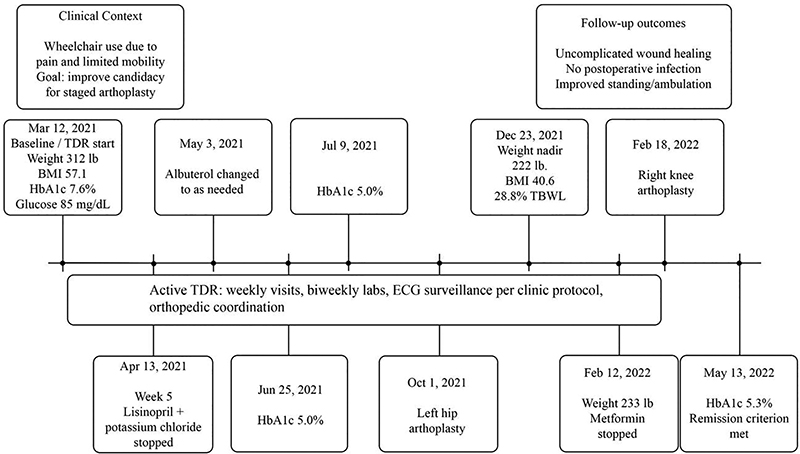
Figure 1. CARE-style timeline of the clinical course during a medically supervised low-energy total diet replacement before staged arthroplasty. The timeline shows baseline evaluation, initiation of TDR, key medication changes, hemoglobin A1c improvement, left hip arthroplasty, weight nadir, metformin discontinuation, right knee arthroplasty, and follow-up hemoglobin A1c assessment. Body mass index was calculated using height 1.575 m from primary care documentation. Percent total body weight loss was calculated as: (baseline weight − follow-up weight) / baseline weight × 100. TDR, total diet replacement; BMI, body mass index; HbA1c, hemoglobin A1c; TBWL, total body weight loss; ECG, electrocardiogram.
DISCUSSION
This case describes a medically supervised, low-energy TDR pathway used for preoperative optimization in a medically complex patient with severe obesity and T2D before staged arthroplasty. The patient achieved substantial weight loss, medication de-escalation, T2D remission according to consensus criteria, and completion of both planned orthopedic procedures. The primary clinical message is that rapid diet-induced weight loss in high-risk surgical candidates should be treated as a medically managed intervention rather than ordinary dieting. In this case, the pathway required a structured dietary prescription, frequent follow-up, laboratory surveillance, medication reassessment, behavioral support, and communication with the surgical team.
The magnitude of weight loss and glycemic improvement observed in this case is consistent with findings from prior TDR and total meal replacement trials.4,5 However, this patient differed from many trial participants because of severe mobility limitation, chronic prednisone exposure, multiple comorbidities, and an active surgical goal. These factors underscore the importance of close monitoring, particularly for adjustment of antihypertensive medications and potassium supplementation, glycemic therapy, safety symptoms, and perioperative nutritional planning.
This report has important limitations. It describes a single patient treated in a structured specialty program, and causality cannot be inferred. Complete serial laboratory data, objective measures of adherence, and standardized functional outcomes were not available. Baseline HbA1c–glucose discordance and chronic prednisone use introduce uncertainty in the interpretation of glycemic status. Concurrent factors, including postoperative rehabilitation, changes in mobility, altered fluid status, pain control, and temporary dietary interruptions, may have contributed to the observed outcomes. The absence of documented postoperative infection should not be interpreted as evidence that TDR reduced surgical risk.
CONCLUSIONS
A medically supervised, formula-based low-energy TDR pathway was used as part of preoperative optimization before staged arthroplasty in a medically complex patient with severe obesity and T2D. This case illustrates an interdisciplinary approach involving clinical monitoring, medication reassessment, nutritional and behavioral support, and perioperative coordination. Although findings from a single patient cannot establish causality, the observed weight loss, medication de-escalation, T2D remission, and uncomplicated wound healing support further prospective evaluation of structured TDR pathways in selected high-risk surgical candidates.
ADDITIONAL INFORMATION
Written informed consent was obtained from the patient for publication of this case report. Direct identifiers were omitted, and potentially identifying clinical details were limited to those necessary to understand the case. This case report was reviewed by the institutional ethics committee and granted exemption from formal Institutional Review Board oversight, in accordance with local policies governing single-patient case reports.
The authors declare that no financial support was received from any organization for the submitted work and that they have no financial relationships or other relationships that could appear to have influenced the submitted work.
REFERENCES
- Schwarzkopf R, Thompson SL, Adwar SJ, et al. Postoperative complication rates in the “super-obese” hip and knee arthroplasty population. J Arthroplasty. 2012;27:397–401.
- Yang L, Sun Y, Li G, et al. Is hemoglobin A1c and perioperative hyperglycemia predictive of periprosthetic joint infection following total joint arthroplasty? A systematic review and meta-analysis. Medicine (Baltimore). 2017;96:e8805.
- MacMahon A, Rao SS, Chaudhry YP, et al. Preoperative patient optimization in total joint arthroplasty: the paradigm shift from preoperative clearance. HSS J. 2022;18:418–27.
- Ard JD, Lewis KH, Rothberg A, et al. Effectiveness of a total meal replacement program (OPTIFAST program) on weight loss: results from the OPTIWIN study. Obesity (Silver Spring). 2019;27:22–9.
- Lean MEJ, Leslie WS, Barnes AC, et al. Primary care-led weight management for remission of type 2 diabetes (DiRECT): an open-label, cluster-randomised trial. Lancet. 2018;391:541–51.
- Taylor R, Barnes AC. Translating aetiological insight into sustainable management of type 2 diabetes. Diabetologia. 2018;61:273–83.
- Riddle MC, Cefalu WT, Evans PH, et al. Consensus report: definition and interpretation of remission in type 2 diabetes. Diabetes Care. 2021;44:2438–44.
- Gagnier JJ, Kienle G, Altman DG, et al. The CARE guidelines: consensus-based clinical case reporting guideline development. J Clin Epidemiol. 2014;67:46–51.
- Radin MS. Pitfalls in hemoglobin A1c measurement: when results may be misleading. J Gen Intern Med. 2014;29:388–94.
- Roberts A, James J, Dhatariya K. Management of hyperglycaemia and steroid therapy: a guideline from the Joint British Diabetes Societies for Inpatient Care group. Diabet Med. 2018;35:1011–17.
Article citation: Huizar YP, Galyean S, Pagan AF. Medically supervised low-energy total diet replacement before staged arthroplasty in severe obesity and type 2 diabetes. The Southwest Journal of Medicine. 2026;14(61):76–80
From: Department of Psychological Sciences, Texas Tech University, Lubbock, Texas (YH), DreamWell Psychology, El Paso, Texas (YH), Nutritional Sciences, Texas Tech University, Lubbock, Texas (SG), Psychiatry, University of Texas Health Science Center at Houston, Houston, Texas (AP)
Conflicts of interest: none
This work is licensed under a Creative Commons Attribution-ShareAlike 4.0 International License.