Abstract
Outcomes of hospitalizations for heart failure with reduced ejection fraction complicated by cardiac arrest, stratified by pre-existing implantable cardioverter-defibrillator status
Nithila Sivakumar MD, Chanokporn Puchongmart MD, Thitiphan Srikulmontri MD, Dina Soliman MD, Thanaboon Yinadsawaphan MD, Narathorn Kulthamrongsri MD
Corresponding author: Chanokporn Puchongmart
Contact Information: Chanokporn.Puchongmart@ttuhsc.edu
DOI: 10.12746/swjm.v14i61.1687
ABSTRACT
Background: Hospitalizations for heart failure with reduced ejection fraction complicated by cardiac arrest represent a high-risk population, and the role of a pre-existing implantable cardioverter-defibrillator in these patients remains unclear.
Methods: We conducted a retrospective observational study using the National Inpatient Sample from 2016 through 2022. Adult hospitalizations (age 18 years or older) with a diagnosis of heart failure with reduced ejection fraction and cardiac arrest were identified using diagnosis codes. Pre-existing defibrillator status was defined by a code indicating a device present before admission. Outcomes were compared by device status using survey-weighted methods, and a multivariable logistic regression model evaluated the independent association between device status and in-hospital mortality, adjusting for demographics, comorbidities, and clinical severity.
Results: Among 11,945 weighted hospitalizations, 545 (4.6%) had a documented pre-existing defibrillator. Crude in-hospital mortality was higher among hospitalizations with a device than those without (21.1% vs 9.7%, P < 0.01). After adjustment, device status was not independently associated with in-hospital mortality (adjusted odds ratio 1.34, 95% confidence interval 0.63 to 2.84). Do-not-resuscitate status (adjusted odds ratio 15.56) and cardiogenic shock (adjusted odds ratio 1.47) were strongly associated with higher mortality.
Conclusions: In this national sample, pre-existing defibrillators were uncommon. Although crude mortality was higher among patients with a device, device status was not independently associated with in-hospital mortality after adjustment, suggesting outcomes were primarily driven by baseline risk and clinical severity. Studies incorporating arrest rhythm, timing, and device interrogation are needed to clarify mechanisms and optimize post-arrest management.
Keywords: Heart failure, systolic, cardiac arrest, defibrillators, implantable, hospital mortality, National Inpatient Sample, healthcare disparities
INTRODUCTION
Heart failure with reduced ejection fraction (HFrEF) is a major public health problem and a leading contributor to cardiovascular hospitalization and death in the United States.1 Mortality in HFrEF reflects two dominant pathways: progressive pump failure and sudden cardiac death (SCD) from malignant ventricular arrhythmias.2 Current American College of Cardiology guidance supports implantable cardioverter-defibrillator (ICD) therapy for primary prevention in patients with chronic HFrEF and a left ventricular ejection fraction of 35% or less despite guideline-directed medical therapy and an anticipated meaningful survival of more than 1 year, as well as for secondary prevention in patients who survive sustained ventricular tachycardia (VT), ventricular fibrillation (VF), or resuscitated SCD attributed to VT/VF after reversible causes are excluded.3 In contrast, ICDs do not prevent mortality from non-arrhythmic mechanisms such as refractory shock, multi-organ failure, or non-shockable cardiac arrest, and outcomes after cardiac arrest remain poor despite improving survival in contemporary cohorts.4,5
Hospitalizations for HFrEF complicated by cardiac arrest represent a uniquely high-risk subgroup in which pre-existing ICD status may reflect underlying disease phenotype, comorbidity burden, and prior access to advanced heart failure and electrophysiology care. Real-world ICD use is also influenced by persistent sex- and race/ethnicity-associated disparities in counseling and implantation, despite groups at higher SCD risk potentially benefiting when guideline criteria are met.6,7 Although national data describe trends in cardiac arrest outcomes, fewer analyses have focused specifically on HFrEF hospitalizations complicated by cardiac arrest and how outcomes differ by pre-existing ICD status.
To address this gap, we used the National Inpatient Sample (NIS) to quantify the prevalence of pre-existing ICDs among adult HFrEF hospitalizations presenting with cardiac arrest, compare baseline characteristics, in-hospital severity and support, and outcomes by ICD status, and identify factors associated with in-hospital mortality.
METHOD
We conducted a retrospective observational study using the NIS from 2016 through 2022. The NIS is part of the Healthcare Cost and Utilization Project (HCUP) sponsored by the Agency for Healthcare Research and Quality and represents an approximately 20% stratified sample of U.S. community hospital discharges. National estimates were generated using HCUP-provided discharge weights and survey design variables.
STUDY POPULATION
We included adult (age 18 years or older) hospitalizations of patients with HFrEF who presented with cardiac arrest. Cardiac arrest was identified when coded as a primary or secondary diagnosis using International Classification of Diseases, Tenth Revision, Clinical Modification (ICD-10-CM) codes I46.2 “cardiac arrest due to underlying cardiac condition,” I46.8 “other cardiac arrest,” I46.9 “cardiac arrest, cause unspecified,” I49.01 “ventricular fibrillation,” and I49.02 “ventricular flutter.” HFrEF was identified using ICD-10-CM codes in any diagnosis position, including I50.20 “unspecified systolic (congestive) heart failure,” I50.21 “acute systolic (congestive) heart failure,” I50.22 “chronic systolic (congestive) heart failure,” and I50.23 “acute on chronic systolic (congestive) heart failure.” Pre-existing ICD status was defined by ICD-10-CM code Z95.810 “presence of automatic implantable cardiac defibrillator,” indicating a device present prior to the index hospitalization.
COVARIATES
Baseline characteristics included age, sex, and race/ethnicity as provided by the NIS. Comorbidity burden was assessed using the Elixhauser comorbidity index. Markers of in-hospital clinical severity included the presence of VT/VF during the admission, cardiogenic shock, acute respiratory failure, and anoxic brain injury/hypoxic-ischemic brain injury. We also identified do-not-resuscitate (DNR) status using the NIS DNR variable when available. Use of in-hospital mechanical circulatory support was ascertained using International Classification of Diseases, Tenth Revision, Procedure Coding System procedure codes for intra-aortic balloon pump (IABP), Impella, and extracorporeal membrane oxygenation (ECMO).
OUTCOMES
The primary outcome was in-hospital mortality. Secondary outcomes included acute kidney injury, major bleeding, hospital length of stay (LOS), and total hospital charges. Total hospital charges were inflation-adjusted to a common-year U.S. dollar value using the Bureau of Labor Statistics Consumer Price Index to apply a consistent adjustment across all study years.
STATISTICAL ANALYSIS
All analyses were performed using Stata/MP version 18.0 (StataCorp, College Station, TX, USA). NIS survey design elements were incorporated using HCUP-provided discharge weights, hospital-level clustering, and stratification to generate nationally representative estimates. Baseline characteristics, clinical severity variables, and outcomes were compared between groups (pre-existing ICD vs no ICD) using survey-weighted methods. Categorical variables are reported as weighted percentages and compared using design-based tests. Continuous variables are reported as mean ± standard deviation (SD) when approximately normally distributed and as median (interquartile range [IQR]) for skewed distributions; LOS and inflation-adjusted charges were summarized as median (IQR).
To evaluate the independent association between pre-existing ICD status and in-hospital mortality, we fit a multivariable survey-weighted logistic regression model with in-hospital mortality as the dependent variable. The model included demographics, race/ethnicity, comorbidities, and clinical severity variables to adjust for potential confounding. Adjusted odds ratios (aORs) with 95% confidence intervals (CIs) are reported. A two-sided P value less than 0.05 was considered statistically significant.
ETHICS
The NIS contains de-identified, publicly available discharge-level data. This study did not involve direct patient contact and was considered exempt from institutional review board oversight under institutional policy for analyses of de-identified datasets. The study was performed in compliance with the human-studies guidelines of the authors’ institutions.
RESULTS
BASELINE CHARACTERISTICS
Among 11,945 weighted hospitalizations of adults with HFrEF complicated by cardiac arrest, 545 (4.6%) had a documented pre-existing ICD. Baseline characteristics are shown in Table 1. Compared with hospitalizations without an ICD, those with a pre-existing ICD were older (66.3 ± 12.9 vs 64.0 ± 13.5 years, P < 0.01) and had a similar sex distribution (female: 24.8% vs 29.8%, P = 0.26). Race/ethnicity differed by ICD status (P = 0.01); hospitalizations with an ICD included a lower proportion of White patients (59.6% vs 71.8%) and a higher proportion of Black patients (26.9% vs 14.6%).
Table 1. Baseline Characteristics by Pre-Existing ICD Status
| Characteristic |
With ICD (N = 545) |
Without ICD (N = 11,400) |
P Value |
| Age, years (mean ± SD) |
66.3 ± 12.9 |
64.0 ± 13.5 |
<0.01 |
| Female, % |
24.8 |
29.8 |
0.26 |
| Race, % |
|
|
0.01 |
| White |
59.6 |
71.8 |
|
| Black |
26.9 |
14.6 |
|
| Hispanic |
4.8 |
7.2 |
|
| Asian/Pacific Islander |
3.9 |
2.5 |
|
| Native American |
0.0 |
0.8 |
|
| Other |
4.8 |
3.1 |
|
| Comorbidities, % |
|
|
|
| Hypertension |
86.2 |
77.4 |
0.03 |
| Diabetes mellitus |
47.7 |
36.3 |
0.01 |
| Cancer |
0.0 |
3.6 |
0.04 |
| Anemia |
12.8 |
5.8 |
<0.01 |
| Cardiac arrhythmias |
87.2 |
89.8 |
0.38 |
| Valvular disease |
23.9 |
18.8 |
0.19 |
| Pulmonary circulation disorders |
17.4 |
11.2 |
0.04 |
| Peripheral vascular disorders |
100.0 |
9.2 |
<0.01 |
| Chronic pulmonary disease |
35.8 |
20.6 |
<0.01 |
| Hypothyroidism |
19.3 |
10.0 |
<0.01 |
| Renal failure |
46.9 |
27.7 |
<0.01 |
| Liver disease |
11.9 |
17.9 |
0.11 |
| Coagulopathy |
19.3 |
16.0 |
0.36 |
| Obesity |
17.4 |
19.9 |
0.53 |
| Weight loss |
7.3 |
8.1 |
0.78 |
| Fluid & electrolyte disorders |
55.1 |
61.0 |
0.21 |
| Alcohol abuse |
4.6 |
7.9 |
0.21 |
| Drug abuse |
5.5 |
6.4 |
0.71 |
Patients with pre-existing ICDs had a higher prevalence of several comorbidities, including hypertension (86.2% vs 77.4%, P = 0.03), diabetes mellitus (47.7% vs 36.3%, P = 0.01), anemia (12.8% vs 5.8%, P < 0.01), pulmonary circulation disorders (17.4% vs 11.2%, P = 0.04), peripheral vascular disorders (100.0% vs 9.2%, P < 0.01), chronic pulmonary disease (35.8% vs 20.6%, P < 0.01), hypothyroidism (19.3% vs 10.0%, P < 0.01), and renal failure (46.9% vs 27.7%, P < 0.01). Cancer was less frequently coded among ICD hospitalizations (0.0% vs 3.6%, P = 0.04). Other comorbidities did not differ significantly between groups.
CLINICAL SEVERITY AND IN-HOSPITAL SUPPORT
Clinical severity and in-hospital support measures are shown in Table 2. VT/VF during admission was common in both groups and did not differ by ICD status (73.4% vs 71.1%, P = 0.60). Cardiogenic shock (14.7% vs 24.7%, P = 0.02) and acute respiratory failure (50.5% vs 63.7%, P < 0.01) were less frequently coded among ICD hospitalizations. Rates of anoxic brain injury were similar (19.3% vs 19.7%, P = 0.92). DNR status was slightly higher in the ICD group (17.4% vs 13.6%, P = 0.25). Use of mechanical circulatory support was numerically lower among ICD hospitalizations, including IABP (4.6% vs 9.9%, P = 0.07), Impella (3.7% vs 5.3%, P = 0.45), and ECMO (0.9% vs 1.2%, P = 0.77), though these differences did not reach statistical significance.
Table 2. Clinical Severity and In-Hospital Support by Pre-Existing ICD Status
| Clinical Severity and Support |
With ICD (N = 545) |
Without ICD (N = 11,400) |
P Value |
| VT/VF during admission, % |
73.4 |
71.1 |
0.60 |
| Clinical Severity/Status, % |
|
|
|
| Cardiogenic shock |
14.7 |
24.7 |
0.02 |
| Acute respiratory failure |
50.5 |
63.7 |
<0.01 |
| Anoxic brain injury |
19.3 |
19.7 |
0.92 |
| DNR status |
17.4 |
13.6 |
0.25 |
| Mechanical Support, % |
|
|
|
| IABP use |
4.6 |
9.9 |
0.07 |
| Impella use |
3.7 |
5.3 |
0.45 |
| ECMO use |
0.9 |
1.2 |
0.77 |
IN-HOSPITAL OUTCOMES
In-hospital outcomes are presented in Table 3. Crude in-hospital mortality was higher among hospitalizations with a pre-existing ICD compared with those without an ICD (21.1% vs 9.7%, P < 0.01). Rates of acute kidney injury were similar between groups (51.4% vs 48.0%, P = 0.49). Major bleeding was numerically lower in the ICD group (8.7% vs 14.8%, P = 0.06). Median LOS was shorter among ICD hospitalizations (6 [IQR 3 to 12] vs 8 [IQR 4 to 13] days, P < 0.01). Median inflation-adjusted hospital charges were also lower in the ICD group ($106,004 [IQR 58,446 to 209,043] vs $184,033 [IQR 104,919 to 317,828], P < 0.01).
Table 3. In-Hospital Outcomes by Pre-Existing ICD Status
| Outcome |
With ICD (N = 545) |
Without ICD (N = 11,400) |
P Value |
| In-hospital mortality, % |
21.1 |
9.7 |
<0.01 |
| Acute kidney injury, % |
51.4 |
48.0 |
0.49 |
| Major bleeding, % |
8.7 |
14.8 |
0.06 |
| LOS, days (median [IQR]) |
6 (3–12) |
8 (4–13) |
<0.01 |
| Inflation-adjusted charges, $ (median [IQR]) |
106,004 (58,446–209,043) |
184,033 (104,919–317,828) |
<0.01 |
In-hospital mortality among hospitalizations without a pre-existing ICD remained relatively stable overall, ranging from 5.3% to 15.6% (15.6% in 2016 and 12.4% in 2022). In contrast, mortality among those with a pre-existing ICD improved over time, falling from 46.2% in 2016 to 4.5% in 2021 before rising to 13.6% in 2022, as illustrated in Figure 2.
FACTORS ASSOCIATED WITH IN-HOSPITAL MORTALITY
After adjustment, pre-existing ICD status was not independently associated with in-hospital mortality (aOR 1.34, 95% CI 0.63 to 2.84), as summarized in Table 4 and Figure 1. VT/VF during admission was associated with lower odds of in-hospital mortality (aOR 0.67, 95% CI 0.48 to 0.94). Cardiogenic shock remained associated with higher mortality (aOR 1.47, 95% CI 1.03 to 2.09), while acute respiratory failure showed a nonsignificant trend toward higher mortality (aOR 1.41, 95% CI 0.96 to 2.06). DNR status was strongly associated with in-hospital mortality (aOR 15.56, 95% CI 11.00 to 22.01). Compared with White patients, Black race (aOR 1.62, 95% CI 1.05 to 2.48) and other race categories (aOR 2.83, 95% CI 1.40 to 5.74) were associated with higher mortality. Other covariates were not significantly associated with mortality in the adjusted model in Table 4.
Table 4. Factors Associated with In-Hospital Mortality
| Predictor |
aOR |
95% CI |
P Value |
| Presence of ICD |
1.34 |
0.63–2.84 |
0.45 |
| Age, years |
0.99 |
0.98–1.00 |
0.09 |
| VT/VF during admission |
0.67 |
0.48–0.94 |
0.02 |
| Female |
0.89 |
0.62–1.27 |
0.52 |
| Race (vs White) |
|
|
|
| Black |
1.62 |
1.05–2.48 |
0.03 |
| Hispanic |
1.35 |
0.74–2.45 |
0.33 |
| Asian/Pacific Islander |
1.30 |
0.44–3.83 |
0.64 |
| Native American |
1.22 |
0.16–9.44 |
0.85 |
| Other races |
2.83 |
1.40–5.74 |
<0.01 |
| Comorbidities |
|
|
|
| Hypertension |
1.00 |
0.65–1.54 |
0.99 |
| Diabetes mellitus |
1.35 |
0.98–1.87 |
0.07 |
| Pulmonary circulation disorder |
1.33 |
0.87–2.04 |
0.19 |
| Peripheral vascular disorder |
1.75 |
1.06–2.90 |
0.03 |
| Chronic pulmonary disease |
1.25 |
0.87–1.79 |
0.23 |
| Hypothyroidism |
1.33 |
0.82–2.14 |
0.25 |
| Renal failure |
1.30 |
0.91–1.85 |
0.15 |
| Cancer |
0.55 |
0.23–1.31 |
0.18 |
| Anemia |
0.80 |
0.40–1.61 |
0.53 |
| Clinical Severity/Status |
|
|
|
| Cardiogenic shock |
1.47 |
1.03–2.09 |
0.03 |
| Acute respiratory failure |
1.41 |
0.96–2.06 |
0.08 |
| DNR status |
15.56 |
11.00–22.01 |
<0.01 |
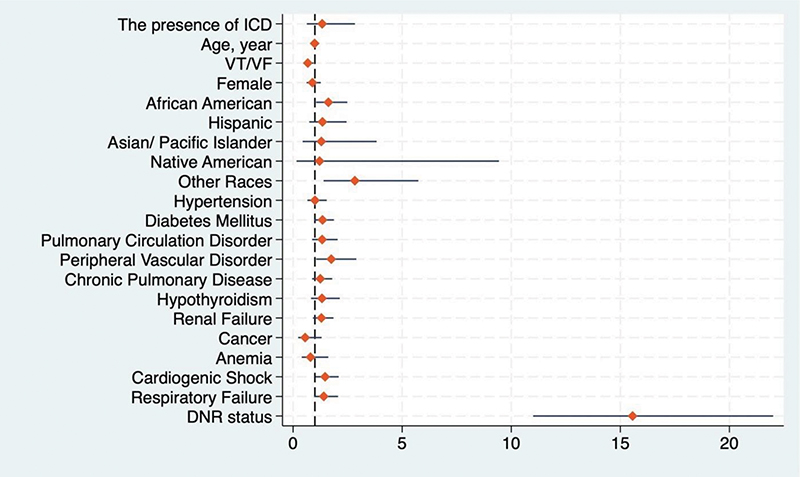
Figure 1. Independent predictors of in-hospital mortality in patients with heart failure with reduced ejection fraction presenting with cardiac arrest. Forest plot from a multivariable survey-weighted logistic regression model showing adjusted odds ratios with 95% confidence intervals for in-hospital mortality. The vertical dashed line indicates no association (adjusted odds ratio = 1.0). The model included pre-existing implantable cardioverter-defibrillator status, age, sex, race/ethnicity, ventricular tachycardia/ventricular fibrillation during admission, comorbidities, cardiogenic shock, acute respiratory failure, and do-not-resuscitate status. Abbreviations: ICD, implantable cardioverter-defibrillator; VT, ventricular tachycardia; VF, ventricular fibrillation; DNR, do-not-resuscitate.
DISCUSSION
ICDs are effective at preventing SCD in appropriately selected HFrEF populations, as demonstrated in pivotal trials and reflected in contemporary guidelines.8–12 However, they do not prevent progressive pump failure, systemic illness, or cardiac arrest due to non-shockable mechanisms, which remain major drivers of mortality in advanced heart failure.4,13
To our knowledge, this is among the first national analyses focused specifically on patients with HFrEF who presented with cardiac arrest. We found that pre-existing ICDs were uncommon, present in only 4.6% of these hospitalizations. Although this estimate does not represent ICD utilization among guideline-eligible candidates, the low prevalence is consistent with real-world evidence of ICD underuse even among patients who meet established indications, with reported uptake as low as 14.2% for primary prevention and 30.2% for secondary prevention.14
Sex and race patterns in our cohort were consistent with previously reported disparities. Only one-quarter of the population was female in both groups, mirroring prior ICD trial cohorts in which women comprised approximately 16% to 29% of enrolled participants.15 Black patients have been reported to have a higher risk of sudden cardiac death and would be expected to benefit from prevention strategies, including ICD therapy when indicated.7 In our data, Black ICD utilization was lower than that reported by Hernandez, Hess, and co-authors among heart failure hospitalizations (15.0% vs 22.6% to 23.0%, respectively), suggesting persistent inequities in device placement.6,16
Comorbidity burden was higher in the ICD group, including hypertension, diabetes, peripheral vascular disorders, chronic pulmonary disease, and renal failure. This pattern highlights systemic comorbidity clustering linked to both ischemic and nonischemic cardiomyopathy phenotypes.4,17 The higher prevalence of peripheral vascular disorders in the ICD group is consistent with prior work by Inglis and co-authors describing a strong association between vascular disease and heart failure.18
Several in-hospital features should be interpreted in the context of limitations of NIS. Although we could not determine the initial arrest rhythm (e.g., pulseless electrical activity/asystole versus VT/VF), VT/VF coded during hospitalization was similar between groups. The observed VT/VF coding prevalence was high (approximately 71% to 73%) but does not confirm VT/VF as the arrest rhythm and may capture arrhythmias occurring before or after the arrest event. This rate exceeds the proportion of shockable rhythms reported in prior studies (15.3% to 38% across in-hospital and out-of-hospital cardiac arrest populations), underscoring the need for rhythm-adjudicated data.19–21
Markers of clinical severity, including cardiogenic shock and respiratory failure, differed between groups, whereas anoxic brain injury was similar at approximately 19%. This estimate is directionally consistent with prior reports using clinical outcomes (13%) and imaging-based post-resuscitation assessments (29%).22,23 DNR status was higher in patients with ICDs than those without (17.4% vs 13.6%, respectively), and mechanical circulatory support use was lower in the ICD group. These findings may reflect differences in underlying disease phenotype and goals-of-care decisions.24
Over the study period, in-hospital mortality among hospitalizations without a pre-existing ICD ranged from 5.3% to 15.6% (15.6% in 2016 and 12.4% in 2022). In contrast, mortality among those with a pre-existing ICD showed greater year-to-year variability but an overall improvement, decreasing from 46.2% in 2016 to 13.6% in 2022 (nadir 4.5% in 2021), as shown in Figure 2.25
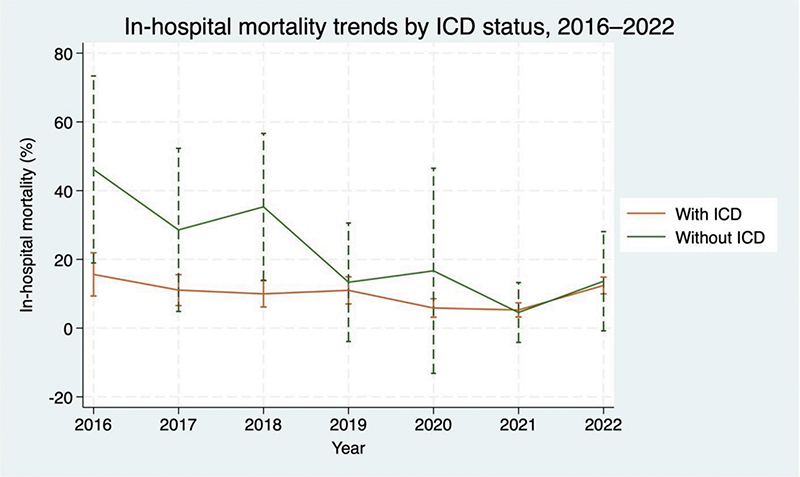
Figure 2. In-hospital mortality by year, stratified by pre-existing implantable cardioverter-defibrillator status from 2016 to 2022. Survey-weighted in-hospital mortality among adult hospitalizations with heart failure with reduced ejection fraction presenting with cardiac arrest, shown separately for those with and without a documented pre-existing device. Point labels indicate the annual mortality percentage for each group. Abbreviations: ICD, implantable cardioverterdefibrillator.
After multivariable adjustment, ICD presence was not independently associated with in-hospital mortality, suggesting the crude mortality difference may be driven by baseline risk and unmeasured severity rather than a direct device effect. In the adjusted model, Black race remained associated with 1.62 times higher in-hospital mortality compared with White patients, and cardiogenic shock was associated with 1.47 times higher in-hospital mortality. This remains clinically important given ongoing excess cardiovascular mortality among Black patients, with Kyalwazi and co-authors reporting an adjusted hazard ratio of 1.30; similarly, in our analysis, Black race was associated with higher in-hospital mortality in this subgroup (aOR 1.62).26
In contrast, VT/VF during hospitalization was associated with 33% lower in-hospital mortality, consistent with long-standing evidence that shockable rhythms have more favorable outcomes than non-shockable rhythms.19–21
Overall, our study emphasizes that HFrEF hospitalizations complicated by cardiac arrest represent a high-risk population in which pre-existing ICD status identifies a subgroup with substantial crude mortality and distinct patterns of resource utilization. These findings support future work integrating the first documented rhythm, device interrogation, treatment, post-cardiac arrest care measures, and DNR timing to clarify mechanisms and determine whether differences in post-arrest care intensity contribute to outcome disparities.
LIMITATIONS
This study has limitations inherent to retrospective analyses of administrative claims data. First, diagnoses and procedures in the NIS are subject to coding misclassification, and we could not verify HFrEF severity, left ventricular ejection fraction values, device programming, shocks delivered, or device malfunction. Second, the NIS captures hospitalizations rather than unique individuals, so repeat admissions cannot be linked, and patient-level longitudinal outcomes are unavailable. Third, key cardiac arrest variables were not available, including arrest location, timing, witnessed status, quality and duration of compression, time-to-defibrillation, neurologic examination, and the initial arrest rhythm; VT/VF codes may reflect arrhythmias occurring before or after the arrest rather than the arrest rhythm itself. Fourth, important clinical confounders such as medications, laboratory values, hemodynamics, imaging findings, and granular measures of illness severity were unavailable, leaving potential residual confounding despite multivariable adjustment. Fifth, DNR status in the NIS does not capture timing or post-arrest decisions, withdrawal of life-sustaining therapy, or the limitations imposed on the interpretation of observed relationships between mortality and resource utilization. Finally, outcomes were limited to the index hospitalization; longer-term survival and neurologic recovery after discharge could not be assessed.
CONCLUSION
Among hospitalizations for HFrEF complicated by cardiac arrest, pre-existing ICDs were documented in approximately 4.6% of cases. Patients with ICDs had higher crude in-hospital mortality; however, after adjustment, ICD status was not independently associated with in-hospital mortality, suggesting outcomes were driven more by baseline risk profile and clinical severity. Cardiogenic shock and Black race were associated with higher in-hospital mortality. Future studies incorporating arrest rhythm, timing, and device interrogation data are needed to clarify mechanisms and guide targeted post-arrest management in this high-risk population.
DATA AVAILABILITY
The data used in this study are available from the Healthcare Cost and Utilization Project (HCUP) National Inpatient Sample (NIS) and are subject to the HCUP Data Use Agreement. The analytic code is available from the corresponding author upon reasonable request.
DECLARATION OF GENERATIVE AI AND AI-ASSISTED TECHNOLOGIES IN THE MANUSCRIPT PREPARATION PROCESS
During the preparation of this work the authors used Claude AI in order to improve language clarity and manuscript organization. After using this tool, the authors reviewed and edited the content as needed and take full responsibility for the content of the published article.
REFERENCES
- Salah HM, Minhas AMK, Khan MS, et al. Causes of hospitalization in the USA between 2005 and 2018. Eur Heart J Open. 2021;1:oeab001.
- Packer M. What causes sudden death in patients with chronic heart failure and a reduced ejection fraction? Eur Heart J. 2020;41:1757–63.
- Russo AM, Desai MY, Do MM, et al. ACC/AHA/ASE/HFSA/HRS/SCAI/SCCT/SCMR 2025 appropriate use criteria for implantable cardioverter-defibrillators, cardiac resynchronization therapy, and pacing. J Am Coll Cardiol. 2025;85:1213–85.
- Heidenreich PA, Bozkurt B, Aguilar D, et al. 2022 AHA/ACC/HFSA guideline for the management of heart failure: a report of the American College of Cardiology/American Heart Association Joint Committee on Clinical Practice Guidelines. Circulation. 2022;145:e895–1032.
- Hyman MC, Deo R. Post-cardiac arrest evaluation: understanding non-shockable rhythms. Eur Heart J. 2019;40:3835–7.
- Hernandez AF, Fonarow GC, Liang L, et al. Sex and racial differences in the use of implantable cardioverter-defibrillators among patients hospitalized with heart failure. JAMA. 2007;298:1525–32.
- Tertulien T, Bush K, Jackson LR 2nd, et al. Racial and ethnic disparities in implantable cardioverter-defibrillator utilization: a contemporary review. Curr Treat Options Cardiovasc Med. 2023;25:771–91.
- Moss AJ, Zareba W, Hall WJ, et al. Prophylactic implantation of a defibrillator in patients with myocardial infarction and reduced ejection fraction. N Engl J Med. 2002;346:877–83.
- Bardy GH, Lee KL, Mark DB, et al. Amiodarone or an implantable cardioverter-defibrillator for congestive heart failure. N Engl J Med. 2005;352:225–37.
- Kadish A, Dyer A, Daubert JP, et al. Prophylactic defibrillator implantation in patients with nonischemic dilated cardiomyopathy. N Engl J Med. 2004;350:2151–8.
- Køber L, Thune JJ, Nielsen JC, et al. Defibrillator implantation in patients with nonischemic systolic heart failure. N Engl J Med. 2016;375:1221–30.
- Al-Khatib SM, Stevenson WG, Ackerman MJ, et al. 2017 AHA/ACC/HRS guideline for management of patients with ventricular arrhythmias and the prevention of sudden cardiac death: executive summary. Circulation. 2018;138:e210–71.
- Zipes DP, Wellens HJ. Sudden cardiac death. Circulation. 1998;98:2334–51.
- Curtis AB, Manrodt C, Jacobsen LD, et al. Guideline-directed device therapies in heart failure: a clinical practice-based analysis using electronic health record data. Am Heart J Plus. 2022;16:100139.
- Barra S, Narayanan K, Garcia R, et al. Time to revisit implantable cardioverter-defibrillator implantation criteria in women. Eur Heart J. 2021;42:1110–12.
- Hess PL, Hernandez AF, Bhatt DL, et al. Sex and race/ethnicity differences in implantable cardioverter-defibrillator counseling and use among patients hospitalized with heart failure. Circulation. 2016;134:517–26.
- Arbelo E, Protonotarios A, Gimeno JR, et al. 2023 ESC guidelines for the management of cardiomyopathies: developed by the task force on the management of cardiomyopathies of the European Society of Cardiology (ESC). Eur Heart J. 2023;44:3503–626.
- Inglis SC, Hermis A, Shehab S, et al. Peripheral arterial disease and chronic heart failure: a dangerous mix. Heart Fail Rev. 2013;18:457–64.
- Girotra S, Nallamothu BK, Spertus JA, et al. Trends in survival after in-hospital cardiac arrest. N Engl J Med. 2012;367:1912–20.
- Oving I, de Graaf C, Karlsson L, et al. Occurrence of shockable rhythm in out-of-hospital cardiac arrest over time: a report from the COSTA group. Resuscitation. 2020;151:67–74.
- Wu L, Narasimhan B, Bhatia K, et al. Temporal trends in characteristics and outcomes associated with in-hospital cardiac arrest: a 20-year analysis (1999–2018). J Am Heart Assoc. 2021;10:e021572.
- Sandroni C, Scarpino M, Antonelli M. Brain death after cardiac arrest: pathophysiology, prevalence, and potential for organ donation. In: Vincent J-L, editor. Annual Update in Intensive Care and Emergency Medicine 2020. Cham: Springer International Publishing; 2020. p. 491–502.
- Schick A, Prekker ME, Kempainen RR, et al. Association of hypoxic ischemic brain injury on early CT after out of hospital cardiac arrest with neurologic outcome. Am J Emerg Med.2022;54:257–62.
- Fu P-K, Yang M-C, Wang C-Y, et al. Early do-not-resuscitate directives decrease invasive procedures and health care expenses during the final hospitalization of life of COPD patients. J Pain Symptom Manage. 2019;58:968–76.
- Vohra AS, Moghtaderi A, Luo Q, et al. Trends in mortality after incident hospitalization for heart failure among Medicare beneficiaries. JAMA Netw Open. 2024;7:e2428964.
- Kyalwazi AN, Loccoh EC, Brewer LC, et al. Disparities in cardiovascular mortality between Black and White adults in the United States, 1999 to 2019. Circulation. 2022;146:211–28.
Article citation: Sivakumar N, Puchongmart C, Srikulmontri T, Soliman D, Yinadsawaphan T, Kulthamrongsri N. Outcomes of hospitalizations for heart failure with reduced ejection fraction complicated by cardiac arrest, stratified by pre-existing implantable cardioverter-defibrillator status. The Southwest Journal of Medicine. 2026;14(61):55–65
From: Department of Internal Medicine, Texas Tech University Health Sciences Center, Lubbock, TX, (NS, CP); Jefferson Einstein Philadelphia Hospital, Philadelphia, PA (TS); John A. Burns School of Medicine, University of Hawaii, Honolulu, HI (TY, NK)
Conflicts of interest: none
This work is licensed under a Creative Commons Attribution-ShareAlike 4.0 International License.