Abstract
Timing of initial post-discharge walk-in bridge clinic visit and outpatient linkage to care in opioid use disorder
Nico Carswell MD, Michaela Mitchell MSc, Samuel Newman MSc, Peter Park MD, Kari Teigen MPH, William McInturf DO, Dustin DeMoss DO
Corresponding author: Nico Carswell
Contact Information: Ncarswell@jpshealth.org
DOI: 10.12746/swjm.v14i61.1692
ABSTRACT
Introduction: Opioid use disorder (OUD) bridge clinics are used as temporary post-discharge “bridges” for OUD treatment after hospital or emergency department (ED) discharge while patients wait to obtain a regular outpatient provider. The objective of this study was to assess whether an earlier initial follow-up after discharge in a walk-in-based OUD bridge clinic is associated with increased linkage to outpatient OUD treatment.
Methods: This was a retrospective cohort study of patients (N = 165, 66% male) referred to a single walk-in, urgent care center-based OUD bridge clinic within a county safety-net hospital system after hospital or ED discharge. A modified Poisson regression model with a log link and robust standard errors was used to estimate adjusted risk ratios and 95% confidence intervals.
Results: There was no significant association between the time until a patient’s first OUD bridge clinic visit after referral at hospital or ED discharge and eventual linkage to outpatient OUD treatment (unadjusted RR, 1.00; 95% CI, 0.99–1.01; p = 0.84).
Discussion: Our study contrasts with previous studies showing that earlier appointments after discharge improve linkage to care among patients with OUD. This may suggest that the walk-in structure of our bridge clinic attenuates the negative impact of delays in follow-up care by allowing patients to present according to their readiness and availability.
Keywords: Buprenorphine, opioid use disorder, bridge clinic, post-discharge, follow-up
INTRODUCTION
The prevalence of opioid use disorder (OUD) has increased and is estimated to affect approximately 2.2% of the United States population, or over 6 million people.1 Opioid use disorder is associated with an increased risk of infection, including HIV, hepatitis, cellulitis, abscesses, endocarditis, and septic arthritis,2 and opioid-related hospitalizations have risen to a rate of 296.9 per 100,000 population.3 Opioids were involved in 81,806 overdose deaths in the United States in 2022.4 The total economic cost of OUD, including costs related to healthcare, criminal justice, lost productivity, reduced quality of life, and death, is estimated to be around $1 trillion.5 With the rise in the number of patients with OUD presenting to the hospital, clinicians should take advantage of every opportunity to initiate treatment for OUD and connect them with follow-up services.
Medications for opioid use disorder (MOUD), such as buprenorphine, have proven to be life-saving interventions associated with decreased all-cause mortality.6 When patients are started on MOUD in the hospital or emergency department, it is critical to ensure continuity of care after discharge. Bridge clinics are a low-barrier model of care that acts as a temporary “bridge,” providing early follow-up for OUD treatment while patients are waiting to transition care to a regular outpatient OUD treatment provider. Patients referred to bridge clinics experience higher numbers of MOUD refills, making them to be significantly less likely to experience an overdose than patients receiving traditional care.7 The rapid linkage to care provided by bridge clinics improves patient stability and reduces the need for acute care interventions.8 Bridge clinics provide a critical transitional care model that maximizes the impact of MOUD by ensuring that patients are rapidly and effectively linked to ongoing treatment.9 This low-barrier nature of bridge clinics, often including same-day or rapid appointments, ensures that patients do not experience long waits that may lead to relapse or disengagement, a period of high risk immediately following hospital discharge.10
Understanding the timing of close follow-up after discharge, especially in the setting of OUD, can be crucial in mitigating the cycle of recurrent readmissions.11 One retrospective cohort study of 470 adults found that the median time to first readmission for OUD was 26 days.12 Bridge programs have been implemented to support patients during this vulnerable transition period and reduce readmissions. One study found that 59% of patients attended their first outpatient appointment within an average of 6 days.13 Several studies indicate the ideal time for close follow-up is within a 14-day period following hospital discharge to a step-down setting (e.g., inpatient to residential or partial hospitalization program to intensive outpatient program),14 noting that 50% of patients who engaged in follow-up treatment within 14 days of inpatient discharge did so within the first 48 hours after discharge.15 One hospital study found that the odds of a patient attending the first post-hospital discharge follow-up for OUD were 2.6 times higher if the appointment wait time was 0–1 days versus ≥2 days.16
However, it is unclear whether this association between early follow-up and improved linkage to care would also be seen in a post-discharge OUD bridge clinic that does not use appointments and operates on a walk-in basis. The objective of this study was to assess whether earlier initial follow-up in a walk-in OUD bridge clinic after referral at hospital or emergency department (ED) discharge is associated with increased linkage to outpatient OUD treatment.
METHOD
This was a retrospective cohort study that examined whether the time between hospital or ED discharge and a patient’s first post-discharge visit to a walk-in OUD bridge clinic is correlated with eventual linkage to outpatient OUD treatment. This study was conducted at JPS Health Network, a large public safety-net hospital system in Fort Worth, Texas. The OUD bridge clinic at JPS Health Network is a low-barrier transitional clinic embedded within the urgent care center of our main hospital and operates on a walk-in, no-appointment basis. Patients with OUD who do not already have a regular outpatient provider for OUD treatment are referred to the bridge clinic at hospital or ED discharge and are instructed to present for this initial OUD follow-up visit on a walk-in basis. Patients are typically discharged from the hospital or ED with a 1-week supply of buprenorphine and therefore are usually instructed to follow up within 1 week of discharge, although this may vary based on clinician discretion. At the bridge clinic, transitional care and buprenorphine management are provided until patients are linked with a regular outpatient provider. The project was reviewed and approved by the North Texas Institutional Review Board.
The study period was from May 30, 2023, to June 27, 2025. Inclusion criteria were met if patients received a referral to the OUD bridge clinic from either an inpatient hospital encounter or the medical or psychiatric ED. Additionally, patients had to have completed their first visit at the bridge clinic, have a documented last bridge clinic visit, and have available demographic information. Those who were referred from an outpatient setting were excluded.
Linkage to care was defined as having a buprenorphine prescription from an outpatient encounter after the patient’s final bridge clinic visit. This was used as a surrogate for linkage to care because it implies that the patient’s care had transitioned to a regular outpatient provider who was managing their buprenorphine. Buprenorphine prescriptions were used rather than other MOUD because the JPS Health Network bridge clinic does not manage patients receiving other MOUD.
Patients were considered “lost to care” if there was no outpatient, non-bridge clinic buprenorphine prescription within 120 days of their final bridge clinic visit. This implied that the patient was not connected to outpatient care after completing the bridge clinic program. The outcome variable was binary, with patients assigned a value of “1” if they had been linked to care within 120 days of their final bridge clinic visit and “0” if they were not linked to care (lost to care). The primary explanatory variable was the number of days from referral to the first bridge clinic visit. Patients’ sex and race/ethnicity were included as covariates to control for potential confounders. A modified Poisson regression model with a log link and robust standard errors was used to estimate adjusted risk ratios and 95% confidence intervals. The statistical tests were two-sided, and hypotheses were evaluated at a significance level of α = 0.05.
RESULTS
There were 1,156 referrals to the OUD bridge clinic from May 30, 2023, to June 27, 2025. Among these records, 794 were excluded because they did not have a documented initial bridge clinic visit, 159 were excluded because they did not have a documented final bridge clinic visit, 20 were excluded because demographic information was not available, and 18 were excluded because they were not referred from a department of interest (these patients were referred from an outpatient encounter). This resulted in an analytical sample of 165 patients.The analytical sample contained no duplicate patients. The majority of patients were male (66%) and non-Hispanic White (58%). Most patients were referred from medical services, either the medical ED (59%) or the inpatient medical service (24%), while a smaller proportion were referred from psychiatric departments (16%). A slight majority of patients (54%) were linked to outpatient care following their final visit to the bridge clinic. The median number of days from referral at discharge to the first bridge clinic visit was 6, and the median number of days from the last bridge clinic visit to linkage to outpatient care was 13. A detailed description of the sample and outcomes of interest is shown in Table 1.
Table 1. Sample Characteristics and Outcomes (N = 165)
|
Percent (Count) |
| Gender: |
|
| Male |
109 (66) |
| Female |
56 (34) |
| Race/Ethnicity: |
|
| Non-Hispanic White |
96 (58) |
| Black |
37 (22) |
| Hispanic |
32 (20) |
| Referring Department: |
|
| Medical Emergency Department |
98 (59) |
| Inpatient Medical |
40 (24) |
| Inpatient Psychiatric |
15 (9) |
| Psychiatric Emergency Center |
12 (7) |
| Outcomes of Interest |
|
| Linkage to Care* |
89 (54) |
| Lost to Care |
76 (46) |
|
Median [IQR] |
| Time from Referral to First Bridge Clinic Encounter |
6 [2; 14] |
| Time from Bridge Clinic to Linkage to Care (n = 89) |
13 [6; 21] |
The results of the modified Poisson regression model are shown in Table 2. The unadjusted risk ratio for linkage to care was 1.00 (95% CI, 0.99–1.01; p = 0.84), indicating that the number of days between referral and the first bridge clinic visit was not significantly associated with linkage to outpatient care after the final bridge clinic visit. A visualization of the unadjusted regression model is shown in Figure 1. The risk ratio did not change after accounting for patient sex and race/ethnicity, as shown by the adjusted risk ratio of 1.00 (95% CI, 0.99–1.01; p = 0.82).
Table 2. Results from Logistic Regression Model on Linkage to Care* (N = 165)
|
Unadjusted Risk Ratio |
Adjusted Risk Ratio |
Adjusted 95% Confidence Interval |
Adjusted P-Value |
| Days from Referral to First Bridge Clinic Visit |
1.00 |
1.00 |
(0.99, 1.01) |
0.82 |
| Patient Sex (Reference = Male) |
– |
0.98 |
(0.63, 1.52) |
0.91 |
| Race/Ethnicity (Reference = White): |
|
|
|
|
| Hispanic |
– |
0.98 |
(0.56, 1.74) |
0.96 |
| Black |
– |
1.28 |
(0.78, 2.09) |
0.33 |
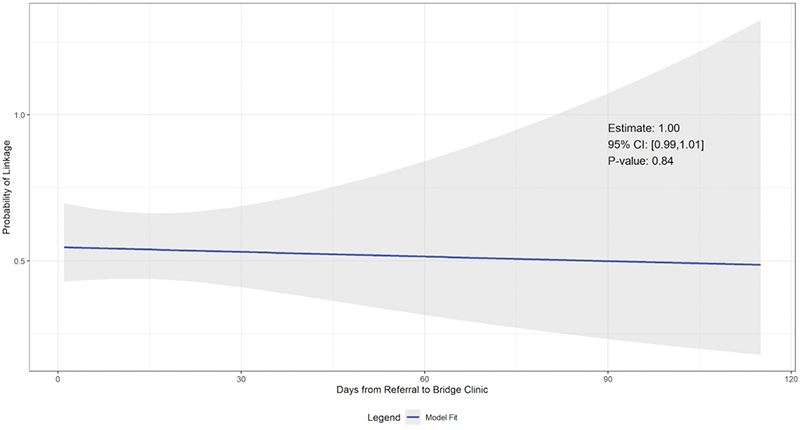
Figure 1. Plot of unadjusted modified Poisson regression model of association between number of days from referral at hospital or ED discharge to first OUD bridge clinic visit and linkage to outpatient care (N = 165).
DISCUSSION
This study did not find a significant association between the time from referral to the initial bridge clinic visit and outpatient linkage to care, demonstrating that patients who took longer to follow up in the bridge clinic had similar linkage-to-care outcomes as those who followed up earlier after hospital or ED discharge.
This may initially appear to contradict earlier studies that emphasized the importance of early follow up after discharge, such as Roy et al. who showed that outpatient wait times of 0–1 days for buprenorphine after hospital discharge significantly increased the odds of attending post-discharge care compared with wait times of ≥2 days.16
However, this may reflect the unique structural features of our model. Unlike many bridge clinics that require scheduled appointments, our clinic is embedded within an urgent care setting and operates entirely on a walk-in basis without scheduled visits. This design may attenuate the negative impact of delays in follow-up care by allowing patients to present according to their readiness and availability. Patients with OUD may delay their care for various reasons, including financial, psychosocial, and attitudinal factors.17 In contrast to traditional appointment-based systems, where delays can function as a barrier, a walk-in structure may maintain accessibility even when patients delay seeking care.
Overall, our findings are consistent with broader evidence supporting bridge models as effective transitional care interventions. Laks et al. demonstrated that methadone initiation within a bridge clinic facilitated linkage to opioid treatment programs, highlighting the importance of immediate medication access combined with structured transition planning.18 Lynch et al. further showed that a telemedicine bridge clinic improved access and reduced costs while maintaining treatment engagement, reinforcing that flexibility and low-barrier access—whether in person or virtual—are key components of successful models.19 Qualitative work by Snow et al. similarly emphasizes the patient-reported benefits of nonjudgmental, rapid-access bridge settings.8 Collectively, these studies suggest that bridge clinics function not only as scheduling accelerators but also as engagement platforms that stabilize patients during a high-risk transition period.
When access is structurally flexible, such as through our walk-in bridge clinic, differences in referral-to-visit timing may play a smaller role in long-term care linkage than previously suggested. Other factors, including social determinants of health, psychiatric comorbidity, transportation, housing stability, prior MOUD experience, and patient readiness—may also contribute to sustained engagement and represent important areas for future study, although these were not assessed in the present study. Consistent with prior literature demonstrating that MOUD retention is multifactorial,7,20 further research should examine how these structural and patient-level variables interact with bridge clinic access models to influence long-term treatment continuity.
This study has several limitations. It was conducted at a single safety-net health system and included a relatively small sample, limiting generalizability. Inclusion required a documented electronic referral and a completed bridge clinic visit, excluding patients referred verbally or those who never presented, which may have biased results toward more adherent individuals. Linkage to care was defined by records obtained within our system and may not have captured care received elsewhere. Future research should evaluate broader patient populations, incorporate social determinants of health, and compare walk-in versus appointment-based bridge models prospectively.
In conclusion, among patients who engaged with our urgent care center–based, walk-in bridge clinic, the time from referral to the first visit was not associated with subsequent linkage to outpatient care. These findings suggest that, in a low-barrier, urgent care–embedded model, structural accessibility through walk-in visits may help patients successfully link to OUD treatment even when they are initially ambivalent or delay care after hospital or ED discharge. This highlights that ensuring low-barrier access to transitional care is critical to supporting continuity of care for individuals with OUD.
REFERENCES
- Substance Abuse and Mental Health Services Administration. Key substance use and mental health indicators in the United States: Results from the 2022 national survey on drug use and health [Internet]. Center for Behavioral Health Statistics and Quality, Substance Abuse and Mental Health Services Administration; 2023. Available from: https://www.samhsa.gov/data/report/2022-nsduh-annual-national-report
- Taylor JL, Samet JH. Opioid Use Disorder. Ann Intern Med. 2022;175(1):ITC1–16.
- Owens P, Weiss A, Barrett M. Hospital burden of opioid-related inpatient stays: Metropolitan and rural Hospitals, 2016. Agency for Healthcare Research and Quality; 2020 [cited 2025 Mar 25]. Available from: https://hcup-us.ahrq.gov/reports/statbriefs/sb258-Opioid-Hospitalizations-Rural-Metro-Hospitals-2016.jsp
- Dowell D, Brown S, Gyawali S, et al. Treatment for Opioid Use Disorder: Population Estimates — United States, 2022. MMWR Morb Mortal Wkly Rep. 2024;73(25):567–74.
- Florence C, Luo F, Rice K. The economic burden of opioid use disorder and fatal opioid overdose in the United States, 2017. Drug Alcohol Depend. 2021;218:108350.
- Santo T, Clark B, Hickman M, et al. Association of Opioid Agonist Treatment With All-Cause Mortality and Specific Causes of Death Among People With Opioid Dependence: A Systematic Review and Meta-analysis. JAMA Psychiatry. 2021;78(9):979–93.
- Marcovitz D, Dear ML, Donald R, et al. Effect of a Co-Located Bridging Recovery Initiative on Hospital Length of Stay Among Patients With Opioid Use Disorder: The BRIDGE Randomized Clinical Trial. JAMA Netw Open. 2024;7(2):e2356430.
- Snow RL, Simon RE, Jack HE, et al. Patient experiences with a transitional, low-threshold clinic for the treatment of substance use disorder: A qualitative study of a bridge clinic. J Subst Abuse Treat 2019;107:1–7.
- Tofighi B, McNeely J, Yang J, et al. Outcomes of a NYC Public Hospital System Low-Threshold Tele-Buprenorphine Bridge Clinic at 1 Year. Subst Use Misuse. 2022;57(8):1337–40.
- Taylor JL, Wakeman SE, Walley AY, et al. Substance use disorder bridge clinics: models, evidence, and future directions. Addict Sci Clin Pract. 2023;18(1):23.
- Peterson C, Liu Y, Xu L, Nataraj N, et al. U.S. National 90-Day Readmissions After Opioid Overdose Discharge. Am J Prev Med. 2019;56(6):875–81.
- Moreno JL, Wakeman SE, Duprey MS, et al. Predictors for 30-Day and 90-Day Hospital Readmission Among Patients With Opioid Use Disorder. J Addict Med. 2019;13(4):306–13.
- Christian N, Bottner R, Baysinger A, et al. Hospital Buprenorphine Program for Opioid Use Disorder Is Associated With Increased Inpatient and Outpatient Addiction Treatment. J Hosp Med. 2021;16(6):345–8.
- Waite MR, Heslin K, Cook J, et al. Predicting substance use disorder treatment follow-ups and relapse across the continuum of care at a single behavioral health center. J Subst Use Addict Treat. 2023;147:208933.
- Reif S, Acevedo A, Garnick DW, et al. Reducing Behavioral Health Inpatient Readmissions for People With Substance Use Disorders: Do Follow-Up Services Matter? Psychiatr Serv. 2017;68(8):810–18.
- Roy PJ, Price R, Choi S, et al. Shorter outpatient wait-times for buprenorphine are associated with linkage to care post-hospital discharge. Drug Alcohol Depend. 2021;224:108703.
- Hall NY, Le L, Majmudar I, et al. Barriers to accessing opioid substitution treatment for opioid use disorder: A systematic review from the client perspective. Drug Alcohol Depend. 2021;221:108651.
- Laks J, Kehoe J, Farrell NM, et al. Methadone initiation in a bridge clinic for opioid withdrawal and opioid treatment program linkage: a case report applying the 72-hour rule. Addict Sci Clin Pract. 2021;16(1):73.
- Lynch MJ, Vargas D, Winger ME, et al. A telemedicine bridge clinic improves access and reduces cost for opioid use disorder care. Drug Alcohol Depend Rep. 2024;11:100227.
- Solomon KT, O’Connor J, Gibbons JB, et al. Association Between Hospital Adoption of an Emergency Department Treatment Pathway for Opioid Use Disorder and Patient Initiation of Buprenorphine After Discharge. JAMA Health Forum. 2023;4(3):e230245.
Article citation: Carswell N, Mitchell M, Newman S, Park P, Teigen K, McInturf W, DeMoss D. Timing of initial post-discharge walk-in bridge clinic visit and outpatient linkage to care in opioid use disorder. The Southwest Journal of Medicine. 2026;14(61):66–71
From: Department of Psychiatry, JPS Health Network (NC, SN, KT, WM, DD) Burnett School of Medicine at Texas Christian University (MM) University of Colorado Anschutz School of Medicine (PP)
Conflicts of interest: none
This work is licensed under a Creative Commons Attribution-ShareAlike 4.0 International License.